



News
How to Calculate Layer Cage Capacity for Your Farm Size: A Practical Guide for Poultry Farmers
Source: TBBView: 193How to Calculate Layer Cage Capacity for Your Farm Size: A Practical Guide for Poultry Farmers
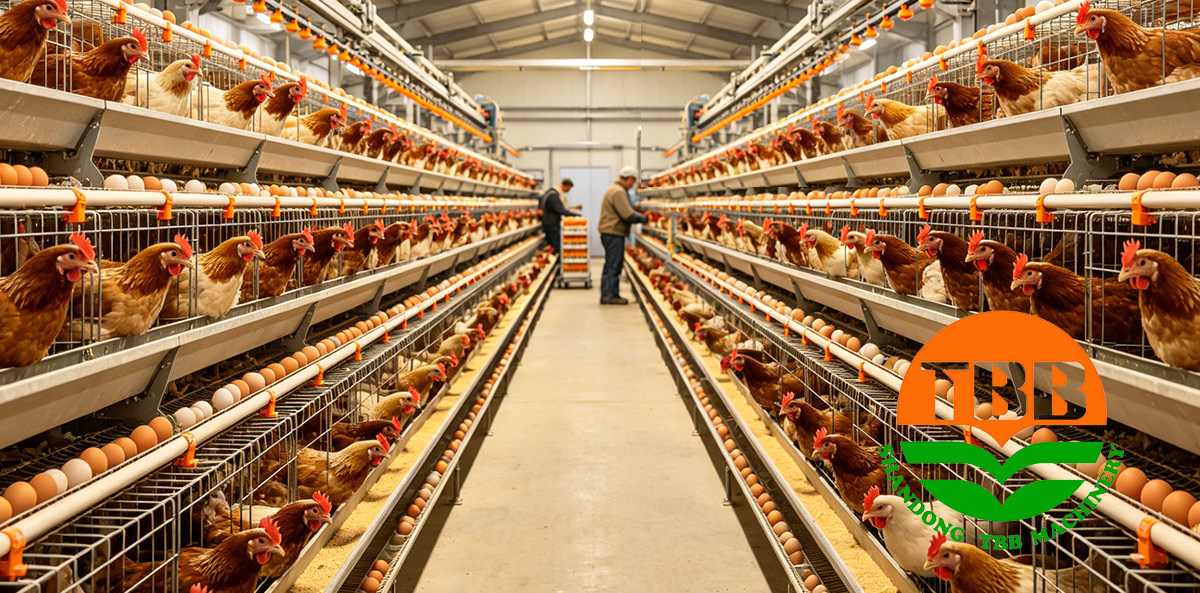
Getting your cage capacity right is one of the most important decisions you'll make when building or expanding a commercial layer operation. Order too few cages and you'll scramble for space. Order too many and you'll waste capital on unused equipment. For poultry farm planning and poultry cage system design, the math behind stocking density and cage configuration directly determines everything from egg production efficiency to bird welfare and long-term farm profitability. Here is a clear, step-by-step method in simple English to calculate exactly how many layer cages your farm needs, no matter the scale.
Step 1 — Start with Your Target Flock Size
Everything begins with one number: how many laying hens (layers) do you plan to keep at full production? Whether you are planning a small-scale layer farm with 2,000 birds or a large commercial egg production facility with 50,000 or more, this number drives every calculation that follows.
If you already have a chicken house built, that's fine — we can work backward from the building dimensions instead. But the cleanest approach is to decide on your desired flock size first, then design the housing around that.
Step 2 — Understand Birds Per Cage (Stocking Density)
Not all layer cages hold the same number of hens. A-type chicken cages and H-type battery cage configurations vary significantly in capacity. Here are some common reference points to guide your poultry equipment selection:
A standard A-type 3-tier layer cage commonly accommodates 90–120 birds per set, depending on the manufacturer and door configuration
A-type 4-tier cages typically house 128–160 layers per set
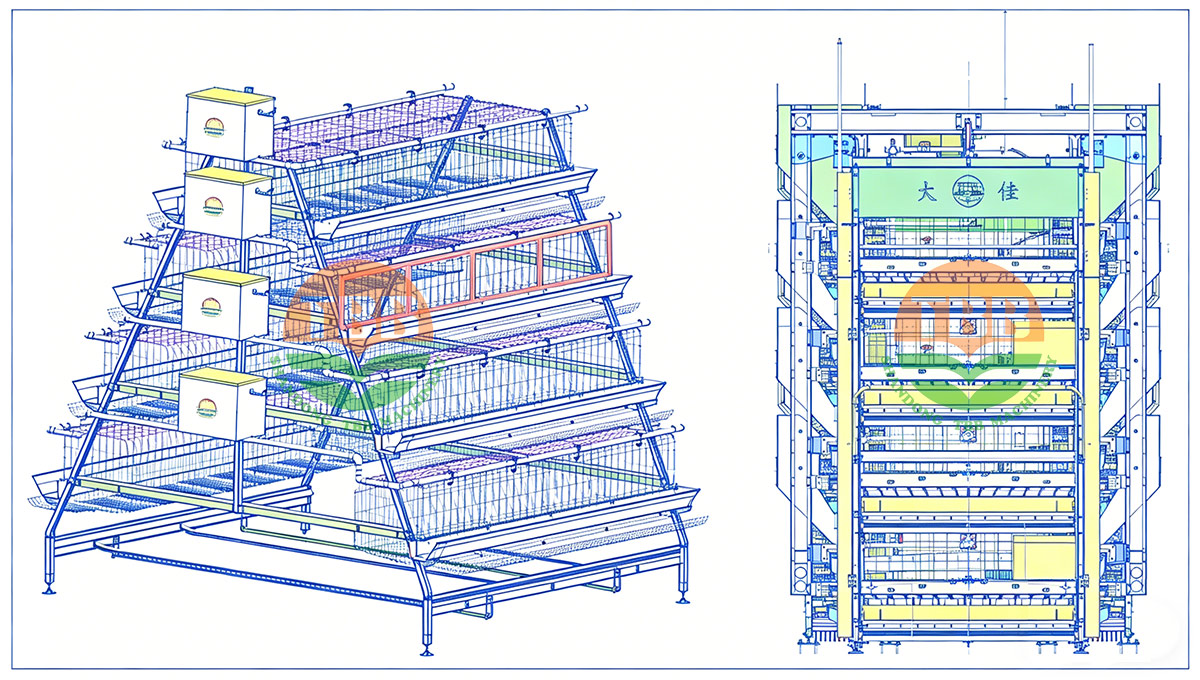
H-type battery cage systems often run 96–128 birds per set in standard configurations
Stocking density in commercial layer farming is typically measured in square centimeters per bird, with 430–500 cm² per hen being the widely accepted range. Many commercial operations target approximately 450 cm² per bird as a practical balance between production intensity and hen welfare.
Step 3 — The Core Calculation Formula
Once you know your target flock size and how many birds each cage set holds, the calculation becomes straightforward:
Number of cage sets needed = Total flock size ÷ Birds per cage set
Let's walk through a real example. Say you want to raise 10,000 commercial layers using A-type 3-tier cages that hold 120 birds per set:
10,000 ÷ 120 = 83.3 — always round up to 84 sets
With a safety margin of 5–10% for flock management flexibility, you might order 88–92 sets
For a larger operation with 30,000 hens using 4-tier cages at 160 birds per set:
30,000 ÷ 160 = 188 sets
This formula remains the same whether you're calculating capacity for an A-frame layer cage design or a fully automated H-type stacked cage system.
Step 4 — Don't Forget Aisle Space and House Dimensions
Cage capacity isn't just about the cages themselves. You must account for the physical space of the poultry house. Key considerations include:
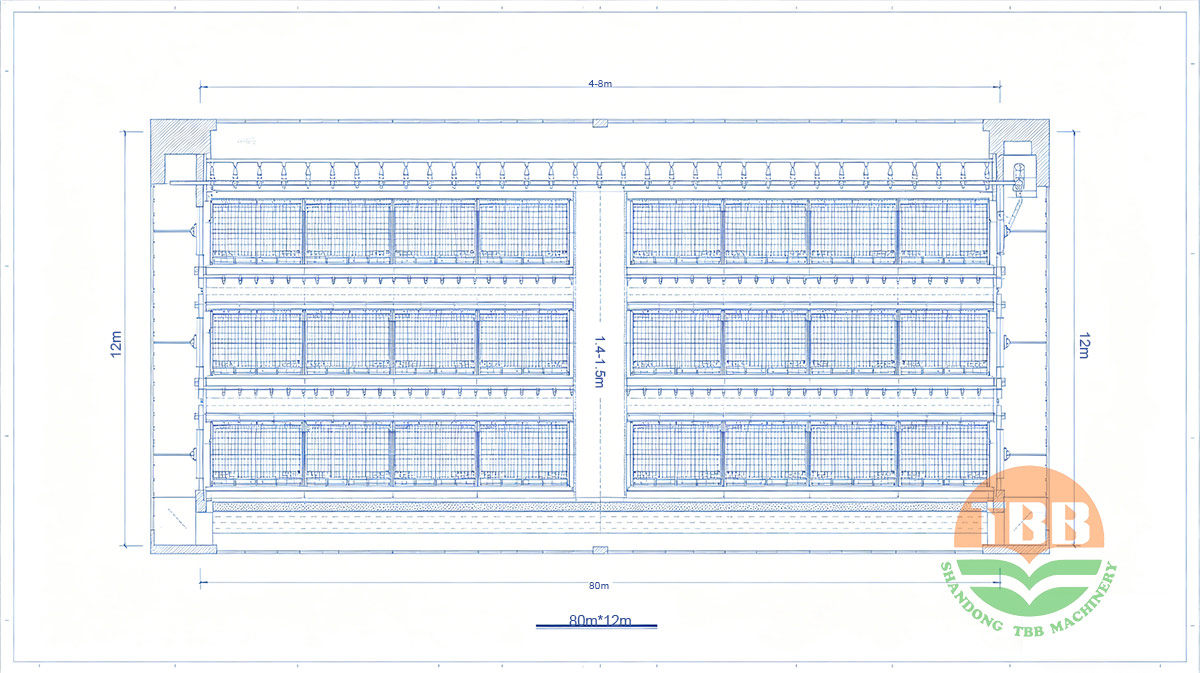
Aisle width: Allow at least 1.4–1.5 meters for central aisles between back-to-back cage rows for feeding, egg collection, and manure removal
End clearance: Reserve 4–8 meters at both ends of the chicken house for equipment and working space
Ceiling height: A 3-tier cage system needs a minimum ceiling height of around 3.0 meters; a 4-tier system requires at least 3.5 meters
For a 5,000-layer farm using 56 sets of 3-tier cages, a typical chicken house might be roughly 35.8 meters long by 12 meters wide, arranged in 4 rows of cages. For 10,000 layers with 90 sets of 3-tier cages, a house of approximately 80 meters long by 12 meters wide in 3 rows is common.
Step 5 — Choosing Between A-Type and H-Type Cage Configurations
Your choice of cage type affects both capacity calculations and overall farm economics:
A-type cages (pyramid shape): More affordable initial investment, simpler manure management, better natural ventilation and lighting. Suitable for small to medium-scale layer farms
H-type cages (stacked): Higher bird density per square meter of floor space, fully compatible with automated feeding, egg collection, and manure belt systems. Ideal for large-scale commercial egg production where labor savings offset the higher upfront cost
For flocks of 5,000–10,000 hens, a 3–4 tier configuration works well. For flocks exceeding 10,000, a 5–6 tier H-type system often delivers better long-term returns.
A Quick-Reference Table for Layer Cage Capacity Planning
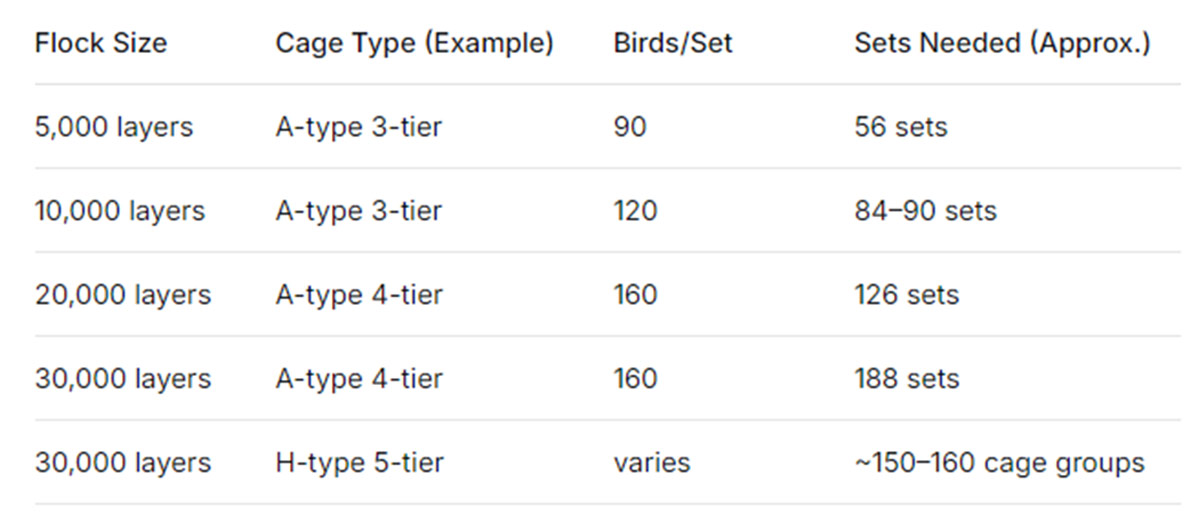
Note: These are indicative numbers based on common industry configurations. Your actual requirements may vary based on cage manufacturer specifications and local regulations.
A Word of Caution: Watch Out for Overstocking
While it's tempting to maximize bird density for higher output, overstocking cages leads to increased mortality, lower egg production per hen, feather pecking, and overall poor flock health. Research consistently shows that moderate stocking densities produce the best balance of bird welfare and farm profitability. Always consult your local animal welfare guidelines and work with a reputable poultry cage manufacturer who can provide a professional farm layout and cage configuration plan tailored to your specific operation.
Getting your cage capacity calculation right from the start saves you from expensive retrofitting and production losses down the road. If you're unsure about the best cage type or configuration for your farm, don't guess — reach out to an experienced poultry equipment provider who can assess your site and recommend the optimal setup.
Need help calculating the right cage capacity for your farm? Get in touch with our team today for a free, no-obligation consultation and farm layout plan. For a limited time, if you reach out now and mention this article, I'll make sure you receive our best discounted pricing of the year on layer cage systems — this is the lowest rate we offer all year, so don't miss it. Contact us now to lock in your quote and take the first step toward a more efficient, profitable layer operation.